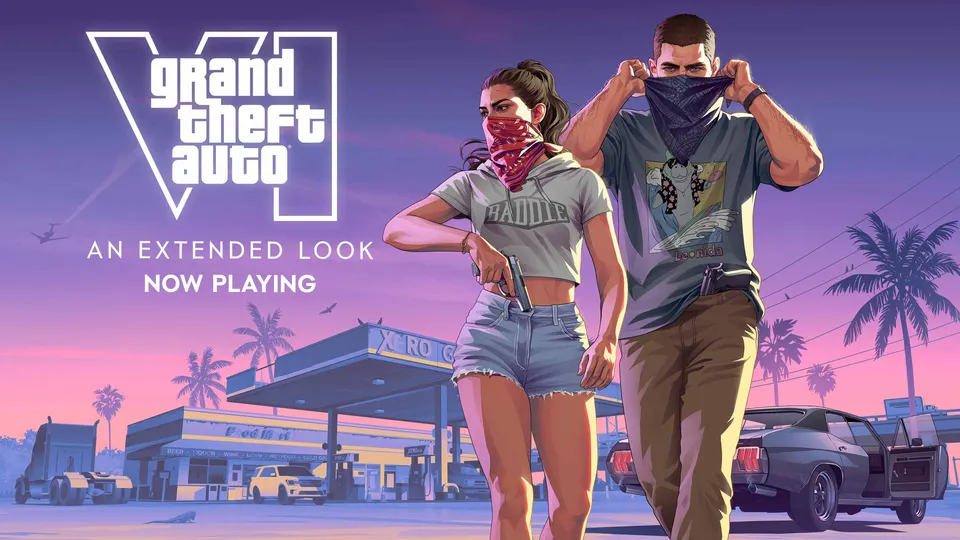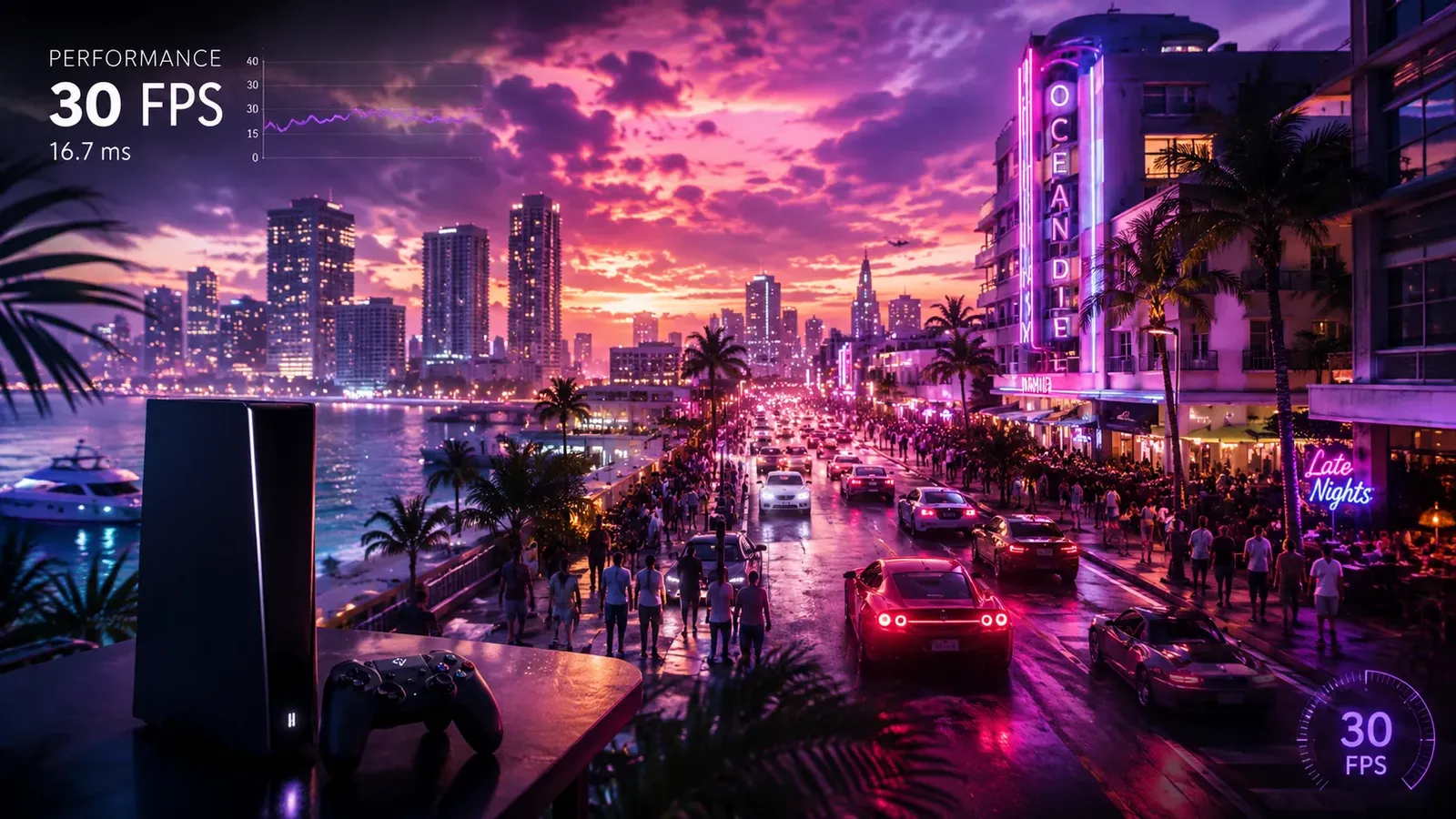
Grand Theft Auto VI finally received its most substantial official showcase yet, and one technical detail has quickly become almost as talked about as Vice City itself: frame rate. Rockstar says the Extended Look released on August 27 was captured entirely from in-game footage on PlayStation 5. Separately, reporting from a Rockstar North preview says current console development builds target 30 frames per second. Rockstar has not announced final launch performance modes, and a 60 FPS option remains unconfirmed.
That does not mean Rockstar has officially ruled out 60 FPS forever. Reporting from a creator visit to Rockstar North says development leadership described 30 FPS as the game’s current console target and could not confirm whether a 60 FPS option would be available at launch or later. With GTA 6 scheduled for November 19, the important distinction is simple: 30 FPS is what has been demonstrated and discussed today; a higher-frame-rate mode remains uncertain.
At first glance, 30 FPS may sound surprising for one of the biggest games of the current console generation. But GTA 6 is not simply trying to render prettier streets. The Extended Look shows an unusually dense world packed with traffic, crowds, detailed interiors, vegetation, reflections and characters behaving simultaneously. Every extra system competing for processor time makes doubling the frame rate substantially harder.
Technical analysis of the showcase helps explain the trade-off. Digital Foundry described the footage as an extraordinary real-time rendering achievement and highlighted the density and complexity Rockstar is pushing on the base PS5. The showcase largely targets 30 FPS, suggesting the game has been designed around maximizing simulation and visual detail rather than sacrificing those systems to chase twice as many frames.
This is also why a more powerful GPU does not automatically guarantee 60 FPS. Large open-world games can become limited by CPU-heavy work such as traffic, pedestrian behavior, physics, animation and world simulation. To move from 30 to 60 FPS, the game effectively has half as much time to prepare each frame. Reducing resolution can ease GPU load, but it cannot magically halve every simulation workload running underneath the image.
For players, the real question is therefore not whether 30 FPS is good or bad in isolation. It is whether Rockstar can deliver consistent frame pacing while preserving the scale shown in the Extended Look. A stable 30 FPS experience can feel far better than an unstable performance mode constantly moving between higher and lower frame rates.
There is still room for Rockstar to offer alternatives. In theory, a 40 FPS mode for 120 Hz displays could become a useful middle ground, and future hardware or an eventual PC release may open the door to higher frame rates. None of those options should be treated as confirmed until Rockstar publishes final performance specifications.
Based on the footage and current technical analysis, GTA 6 appears to be making a familiar Rockstar trade: use the available console performance budget to build a denser, more reactive world rather than make 60 FPS the primary target. If the final game really delivers the level of detail shown in the Extended Look, the debate around 30 FPS may ultimately come down to what players value more: maximum fluidity or a world doing far more every frame.